Here’s a pattern I see in coaching so consistently that I’ve stopped being surprised by it: a leader tells me they never get useful feedback. Their manager’s comments in their review were generic. Their peers don’t say anything beyond pleasantries. Their direct reports respond to “any feedback for me?” with some variation of “nope, everything’s great.”
Then we do a 360-degree feedback process, and the data tells a completely different story. The leader’s peers have specific, substantive observations they’ve been holding for months. The direct reports have concerns they’ve discussed among themselves but never raised. The manager has impressions they’ve never articulated because the leader never seemed to want to hear them.
The feedback existed all along. The leader just didn’t have a system for accessing it. And in the absence of that system, they operated on a self-assessment that was well-intentioned, detailed, and — in several important areas — significantly off.
Why “Any Feedback for Me?” Produces Nothing
The most common way leaders ask for feedback is the most useless: a broad, open-ended question at the end of a meeting or a one-on-one. “Do you have any feedback for me?” “How am I doing?” “Anything I should know?”
These questions fail for three reasons. First, they’re too vague. The person on the receiving end would need to do significant mental work to formulate a useful response on the spot — scanning their memory for relevant observations, deciding which ones are important enough to mention, and figuring out how to frame them diplomatically. That’s a lot to ask in a 30-second window at the end of a meeting.
Second, the power dynamic is working against you. Your direct reports have a strong incentive to tell you things are fine. The risk of raising an issue — potential awkwardness, defensiveness, retaliation — almost always outweighs the benefit, especially when the question feels performative rather than genuine. If you’ve asked “any feedback?” and then moved on without following up, you’ve trained people to understand that the question is a courtesy, not an invitation.
Third, the question puts the burden on the wrong person. You’re asking someone else to do the work of identifying what’s important, when you’re the one who should be guiding the conversation toward the specific areas where input would actually be valuable.
The Specific Question Principle
Useful feedback requires specific questions. Not because people aren’t willing to give you honest input, but because specificity lowers the cognitive and emotional cost of responding. Compare these two asks:
Vague: “Any feedback on how I’m doing?”
Specific: “In our last two team meetings, I’ve been trying to leave more space for other people to weigh in before I share my opinion. Have you noticed any change, or am I still dominating the conversation?”
The first question requires the person to scan their entire experience of working with you and decide what’s worth mentioning. The second question gives them a specific behavior to observe and a specific timeframe to consider. It’s answerable. It’s safe — because you’ve already named the behavior, which signals that you’re aware of it and working on it. And it produces data you can actually use.
The best feedback questions share three characteristics: they reference a specific behavior or situation, they name what you’re trying to do differently, and they invite observation rather than evaluation. You’re not asking “am I good at this?” You’re asking “what did you notice when I did this?” The difference is the difference between a judgment (which people avoid giving) and an observation (which people are much more willing to share).
Finding Your Loving Critics
Organizational psychologist Tasha Eurich, whose self-awareness research I referenced in an earlier post, found that the people who successfully improved their external self-awareness did so by seeking feedback from what she calls “loving critics” — people who have your best interests in mind and are willing to tell you the truth. Not everyone in your orbit qualifies.
Your loving critics are not the people who always agree with you — those are pleasant but useless for development. They’re not the people who are chronically negative — those will give you feedback, but it’s filtered through their own frustration and rarely actionable. Your loving critics are the people who care enough about your success to be uncomfortable on your behalf. They’ll tell you that your presentation missed the mark, that your email came across as dismissive, or that your behavior in last week’s meeting confused the team — not to make you feel bad, but because they know you want to be better and they respect you enough to be honest.
Most leaders have two or three of these people in their orbit. The question is whether you’ve explicitly invited them into that role. There’s a difference between having someone who could give you honest feedback and having someone you’ve actually asked to. Making the invitation explicit — “I’m working on X. Would you be willing to tell me when you see me doing well and when you see me falling back into old patterns?” — changes the relationship from casual observation to active accountability.
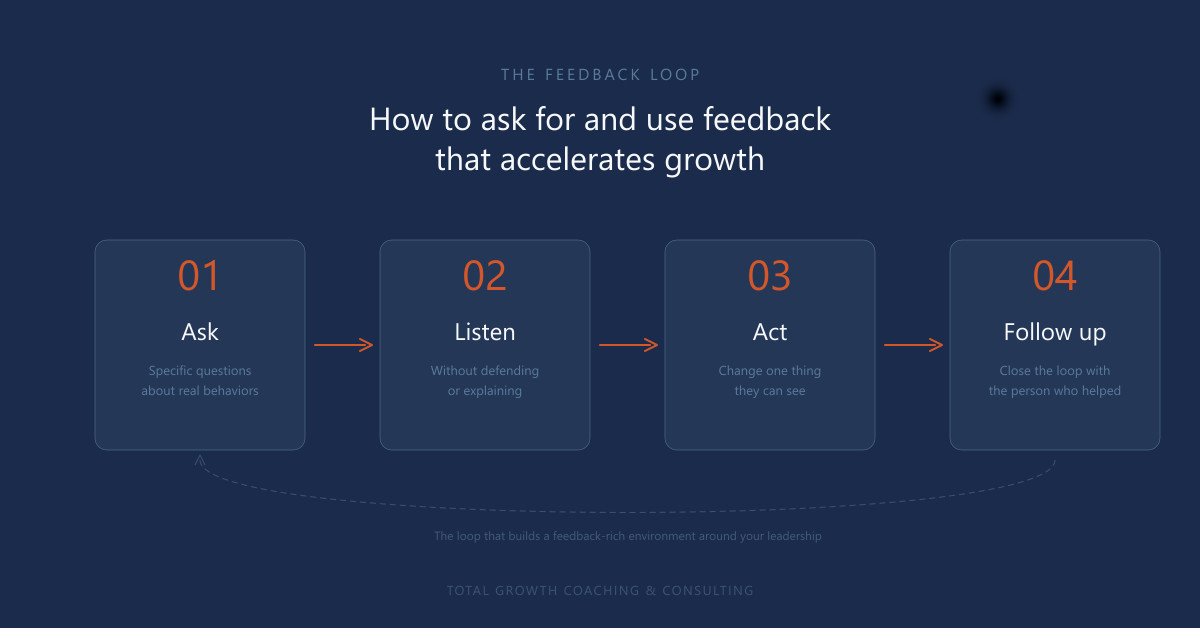
The Feedback Loop: Ask, Listen, Act, Close
Asking for feedback is only the first step. What you do afterward determines whether you’ll ever get honest feedback again. Most leaders have a reliable pattern that kills future input: they ask, they listen politely, and then nothing visibly changes. The person who gave the feedback draws the reasonable conclusion that sharing it wasn’t worth the effort.
Ask with specificity. Target a specific behavior, a recent situation, or a development area you’re actively working on. Make it easy for the other person to respond with something concrete.
Listen without defending. This is where most leaders fail. The instinct when hearing something uncomfortable is to explain, contextualize, or push back. Every time you do that, you teach the person that giving you feedback comes with a cost. The discipline is simple but hard: say “thank you, that’s helpful” and ask a follow-up question. Process your emotional reaction later, on your own time.
Act on something visible. You don’t have to implement every piece of feedback. But you do need to act on something the person can see. If a direct report told you that your one-on-ones feel rushed, and the next three one-on-ones are still 25 minutes of you talking, the feedback loop is broken. Change one thing visibly, even if it’s small.
Close the loop. Go back to the person who gave you the feedback and tell them what you did with it. “You told me I was dominating team meetings. I’ve been holding my comments until the end for the past two weeks. Have you noticed a difference?” This does two things: it gives you a second data point on whether the change is landing, and it signals to the feedback-giver that their input mattered, which makes them much more likely to give you honest input in the future.
When You Need More Than Informal Feedback
The informal feedback loop is powerful for ongoing development, but it has a ceiling. Your loving critics can only see what they’re positioned to see — your behavior in the meetings they attend, the interactions they witness, the decisions they’re close enough to observe. They can’t give you a complete picture because no single person has that vantage point.
That’s where structured tools earn their place. A 360-degree feedback process collects perspectives from your manager, your peers, and your direct reports simultaneously — revealing patterns that no single source could identify. A well-designed 360 shows you the gaps between how you see yourself and how others experience you, which is where the most important development work lives. Combined with a behavioral assessment like the Hogan or EQ-i 2.0, you get both the external perspective and the underlying psychological patterns that explain why the gaps exist.
Three Things You Can Do This Week
1. Prepare one specific feedback question for your next one-on-one. Choose a behavior you’ve been trying to improve or a recent situation where you’re not sure how you landed. Write the question down before the meeting. Make it specific, behavioral, and observational. Try it once and see what you get.
2. Identify your two or three loving critics. Who in your professional life cares about your success and is willing to be honest with you? Write down their names. Now ask yourself: have I explicitly invited them into that role, or am I just hoping they’ll volunteer? If the answer is the latter, have the conversation this week.
3. Close one open feedback loop. Think about the last piece of feedback someone gave you that you actually acted on. Go back to that person and tell them what changed as a result. This single act — closing the loop — does more to build a feedback-rich environment around you than any number of new questions.
Building a feedback practice is one of the highest-leverage habits a leader can develop. But at some point, informal feedback reaches its limit. A structured 360-degree feedback process or a coaching engagement provides the framework to go deeper — collecting perspectives you can’t access informally and connecting the feedback to the behavioral patterns underneath.
Every coaching engagement at TGC&C includes validated assessments and structured feedback as the foundation for development work. We don’t start with what you think you need to work on — we start with what the data says.
Learn about our coaching approach →
Want to talk about building a feedback system around your leadership? A discovery call is a good starting point.