Here’s a sequence of events I’ve watched unfold at dozens of companies. A strong individual contributor gets promoted to manager because they’re excellent at the work. On Monday they’re an engineer, a salesperson, an analyst. On Tuesday they’re responsible for six people’s development, performance, engagement, and career trajectory. Nobody teaches them how to run a one-on-one, give feedback that lands, handle a performance problem, or navigate the moment when a direct report starts crying in a meeting. They figure it out through trial and error — which means their team absorbs the cost of every mistake in the learning curve.
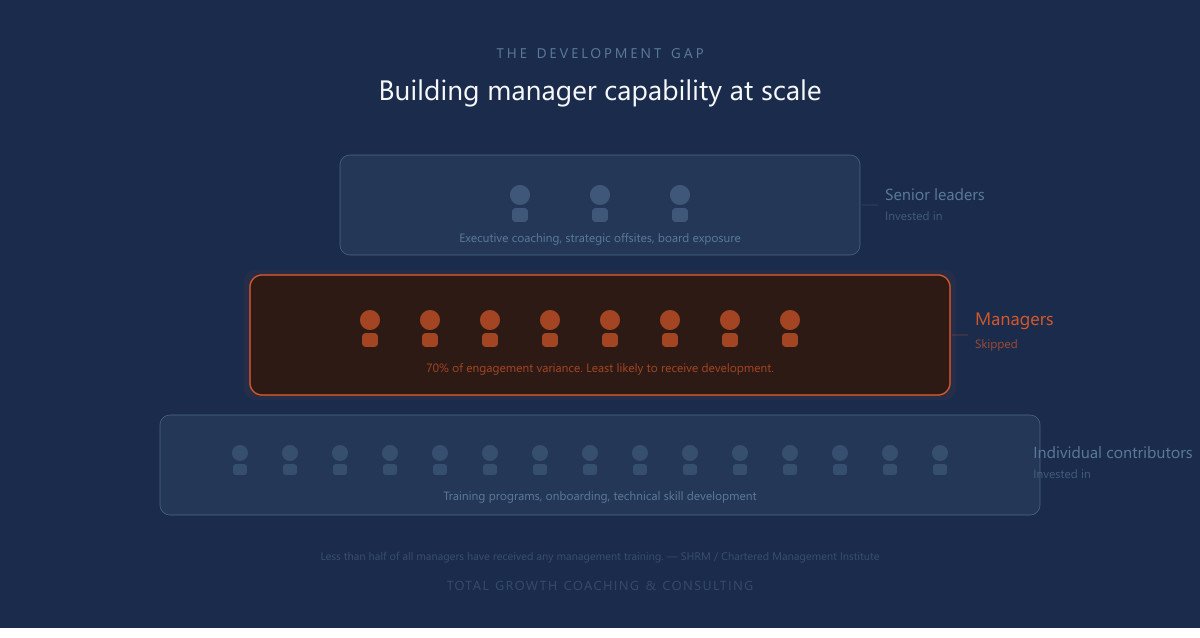
Now multiply that by every manager in the organization. If you have 150 employees and 20 people managers, you have 20 people whose daily behaviors determine whether 130 others are engaged, developing, and staying — or disengaging, stagnating, and updating their resumes. Gallup’s data is unambiguous on this: managers account for roughly 70% of the variance in team engagement scores. Your managers are your most important people infrastructure. And at most growing companies, they’re also the least developed.
Companies invest in executive coaching for their senior leaders and training programs for their individual contributors. The layer in between — the frontline and mid-level managers who actually determine the daily experience of most employees — gets overlooked. Not intentionally. It just doesn’t have a budget line or an obvious owner. And that gap is one of the most expensive silent problems in a growing organization.
Why the “Send Them to a Workshop” Model Fails
The typical response to a manager development need is a one-time training event: a half-day workshop on giving feedback, a lunch-and-learn on difficult conversations, a two-day offsite with a motivational speaker. These events produce a predictable result: a burst of energy and good intentions that decays within two weeks as the daily demands of management reassert themselves.
This isn’t because workshops are useless. Good workshops build awareness and introduce frameworks. But awareness is the 10% — the starting point, not the destination. The 70-20-10 model that underpins most serious leadership development research says that 70% of development happens through on-the-job practice, 20% through coaching and mentoring relationships, and only 10% through formal learning. A workshop is a 10% intervention applied to a 70% problem. It’s not that the training was bad. It’s that training alone was never going to be enough.
The companies that actually develop manager capability at scale don’t rely on events. They build systems — repeatable, structured approaches that develop managers over months, not days, and that connect learning to practice to accountability in a way that changes behavior rather than just building awareness.
What a Manager Development System Actually Looks Like
A system is different from a program. A program has a start date and an end date. A system is ongoing infrastructure that develops managers continuously. Here are the five components that make it work:
1. A defined set of manager expectations. Before you can develop managers, you need to be explicit about what you expect them to do. Most companies have job descriptions for manager roles that describe the technical scope (“oversee the marketing team”) but not the people management behaviors. A manager expectations framework defines the specific behaviors every people manager is responsible for: running regular one-on-ones, delivering timely feedback, conducting performance conversations, supporting development, escalating issues appropriately, and modeling the company’s values. Until these expectations are written down and communicated, you can’t develop against them or hold anyone accountable for them.
2. Structured learning in cohorts, not isolation. The most effective manager development happens in peer groups. When a first-time manager realizes that the person sitting next to them is dealing with the same performance conversation anxiety, the same delegation struggle, and the same imposter syndrome — the isolation breaks. Cohort-based learning creates a peer network that persists long after the formal program ends. It also builds consistency across the organization: every manager learns the same frameworks, uses the same language, and operates from the same expectations. That consistency is what scales.
3. Practice between sessions, not just content during them. Every learning session should end with a specific behavioral assignment that the manager practices before the next session. “This week, ask one of your direct reports what you could do differently to better support their development — and just listen.” “Before your next difficult conversation, write down the three things you want the person to leave the conversation knowing.” These experiments are where the real development happens. The learning session introduces the concept; the practice assignment integrates it into the manager’s actual work.
4. Manager-of-manager accountability. The single most important enabler of manager development isn’t the program itself. It’s whether the manager’s own boss reinforces the learning. When a director asks their managers “how did your one-on-ones go this week?” and “what did you learn in the manager session that you’re going to try?” — development gets reinforced. When the director never mentions the program, the manager receives the signal that it’s optional. The system needs explicit buy-in from the leadership layer above the managers being developed. Without it, the best program in the world will fade into irrelevance.
5. Measurement that goes beyond satisfaction scores. Stop measuring whether managers liked the training and start measuring whether their teams are experiencing better management. Engagement survey results broken out by manager. Retention rates by team. 360-degree feedback before and after the development period. These are the metrics that tell you whether manager capability is actually improving — not whether the workshop had good catering. The measurement also creates accountability: when every manager knows that their team’s engagement data is visible to their boss, the development work stops being optional.
Where to Start If You Have Nothing
If your company has never had a systematic approach to manager development, the temptation is to do it all at once: build a competency framework, design a multi-month curriculum, purchase an LMS, and launch the program company-wide. That’s the plan that stalls at the proposal stage because it’s too big, too expensive, and too hard to get leadership alignment on all at once.
Start smaller. Pick the one manager behavior that’s causing the most visible pain — usually it’s either feedback (managers don’t give it or give it badly) or one-on-ones (they don’t happen, or they’re status updates instead of development conversations). Build a 90-day cohort around that single skill. Four sessions, 90 minutes each, with practice assignments between them and a simple measure of whether the behavior changed. If it works, expand. If it doesn’t, you learned something at low cost.
The companies that build the strongest manager cultures didn’t start with a big program. They started with a small, repeatable rhythm that proved its value and earned the right to grow.
Three Things You Can Do This Week
1. Count your managers and ask how many have received any formal management development. Not technical training, not a conference — specific training on how to manage people. At most growing companies, the number is under 20%. That gap between the number of people you’re asking to manage others and the number you’ve equipped to do it well is the size of the opportunity.
2. Ask three managers what they find hardest about leading people. Don’t assume you know. The answers often cluster around giving feedback, handling performance issues, managing former peers, and navigating the tension between doing the work themselves and developing others to do it. The most common answer tells you where to start.
3. Look at your engagement data through the manager lens. If you have engagement survey results, break them out by manager. The variance between the highest-scoring and lowest-scoring teams tells you how much of your engagement picture is driven by manager quality rather than company-wide factors. If the gap is large — and it almost always is — that’s the evidence that investing in manager capability would produce the fastest return.
Manager capability is the layer of people infrastructure that determines whether everything else works. Your engagement strategy, your retention strategy, your performance management system, your cultural aspirations — they all run through your managers. The companies that invest in this layer systematically see the returns in every metric that matters.
We design and deliver manager development programs — from assessment-driven workshops to structured multi-month cohort experiences — built for your specific managers, your company’s stage, and the capabilities that would have the most impact. We also help organizations build the infrastructure to sustain manager development internally after the initial engagement.
Learn about our workshops and training programs →
Not sure where to start? A discovery call is the right first step. We’ll talk through your current manager landscape, what’s working, what’s not, and what approach would make the most sense for your stage.