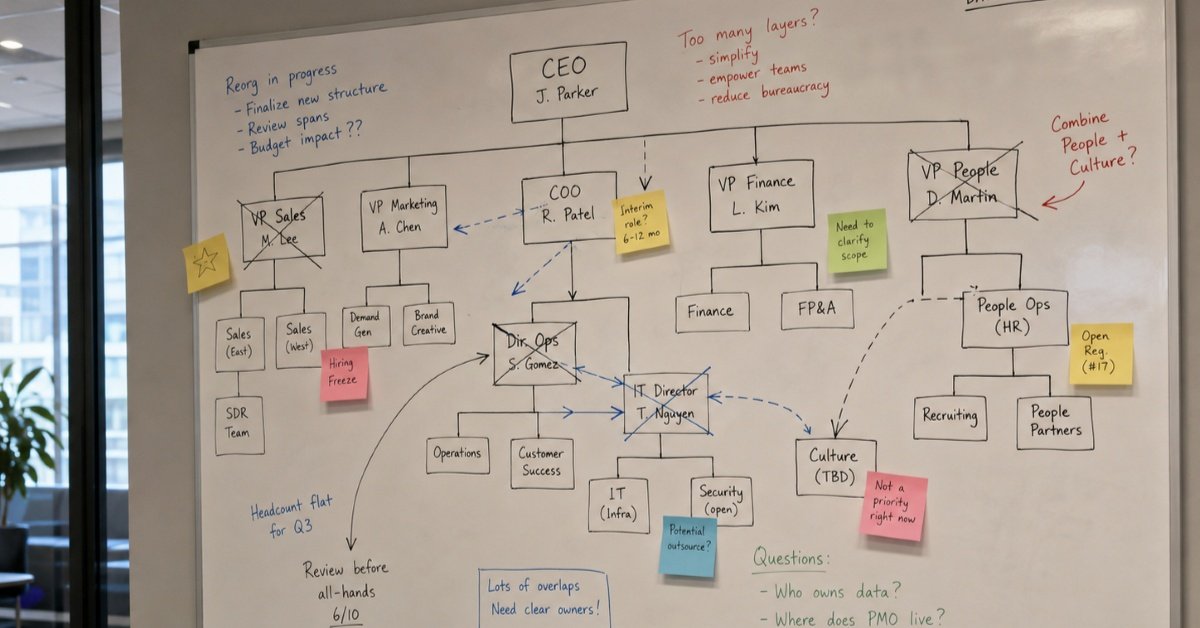
A CEO I advise called me last month with a frustration he couldn’t quite name. “Everything takes too long,” he said. “Decisions that should take a day take two weeks. My VP of Operations has 14 direct reports and can’t develop any of them. We have two teams that seem to be doing the same work, but nobody’s sure enough to say it. I keep thinking I have a people problem, but every time I replace someone, the same issues come back.”
He didn’t have a people problem. He had a design problem. The structure that worked when his company had 80 employees — flat, informal, everyone reporting to three or four senior leaders — was still in place at 220 employees. The org chart hadn’t been intentionally redesigned since the company was half its current size. Decisions were stalling because nobody knew who owned them. Managers were overwhelmed because their spans of control had grown by attrition, not by design. And the duplicate work between teams existed because the roles had never been formally defined when the second team was created — someone just started hiring.
This is one of the most common and most expensive problems at growing companies: the org chart was never designed. It evolved. And what evolves without intention eventually breaks under the weight of complexity.
How Org Charts Evolve (Instead of Being Designed)
In the early stages of a company, the organizational structure is simple by necessity. Everyone reports to the founder. Roles are fluid. People do whatever needs doing. The structure works because the company is small enough that coordination happens through hallway conversations and shared context.
Then the company grows, and the structure changes — but not through design. It changes through a series of reactive decisions: a new hire gets slotted under whoever has capacity. A function splits into two teams because the workload outgrew one person, but nobody redefines the roles or the boundaries. A manager gets promoted and their former peers now report to them, creating a reporting relationship based on seniority rather than strategic logic. An acquisition brings in a team that gets bolted onto the existing structure without integration.
Each of these decisions made sense in the moment. None of them were made as part of a deliberate organizational design. And over time, they accumulate into a structure that nobody designed, nobody can explain, and nobody believes serves the business — but nobody has the bandwidth to fix because they’re too busy navigating the consequences.
The Five Symptoms of a Structure That’s Broken
1. Decisions stall between levels or functions. When people aren’t sure who has decision-making authority, decisions either get escalated unnecessarily or they don’t get made at all. If your leadership team is spending meeting time making decisions that should be handled two levels down, the issue isn’t that people aren’t taking ownership. It’s that the structure doesn’t make ownership clear. Decision rights are a design element, not a personality trait.
2. Manager spans of control are unsustainable. The research on effective span of control is fairly consistent: for most roles, 5–8 direct reports is the range where a manager can effectively develop, support, and hold their team accountable. When a manager has 12 or 15 direct reports, they’re doing triage, not management. One-on-ones become monthly instead of weekly. Development conversations disappear. Performance issues go unaddressed because the manager literally doesn’t have the time. If your spans are consistently above 10, you don’t have a manager effectiveness problem. You have a structural problem that’s preventing managers from being effective.
3. Roles overlap without anyone owning the boundary. This happens when functions grow organically without redefining scope. Two teams start doing similar work because nobody clarified where one team’s responsibility ends and the other’s begins. Customer success and account management both think they own the client relationship. Product and engineering both think they own technical prioritization. The overlap creates confusion for the teams, frustration for the leaders, and an invisible cost in duplicated effort that nobody measures.
4. New hires take too long to understand how things work. When the organizational structure is clear, a new hire can look at the org chart and understand who does what, where decisions get made, and how work flows between teams. When the structure is a product of evolution rather than design, the new hire has to learn the informal reality — which is different from the org chart, takes months to decode, and varies depending on who you ask. If your new hires consistently report confusion about how things work, the issue isn’t onboarding. It’s that the structure itself is confusing.
5. The structure worked at the last stage but doesn’t work at this one. Every growth stage requires a different organizational structure. The flat, founder-led model that works at 30–50 employees breaks between 75 and 150. The functional structure that works at 150 may need to evolve into a divisional or matrix structure by 300–500. If the structure hasn’t been intentionally reviewed at each growth transition, it’s almost certainly mismatched to the current size and complexity of the business.
What to Actually Evaluate
Fixing an org design problem starts with understanding how the organization actually works — not how the chart says it works. In every org design engagement I’ve done, the chart and the reality are meaningfully different. The six things worth evaluating:
Reporting relationships: Do people actually report to who the chart says they report to? Is the reporting structure aligned with how work actually flows, or is it a holdover from a previous stage?
Spans of control: How many direct reports does each manager have? Where are the spans too wide (over 10) and where are they too narrow (under 4)? Wide spans create management quality problems. Narrow spans create unnecessary layers.
Role clarity: For every role on your leadership team, can the person in it and the people around them clearly articulate what they own and what they don’t? Where are the overlaps and the gaps?
Decision rights: Where do decisions get stuck? Which decisions are being escalated unnecessarily? Where does authority live versus where should it live? Mapping decision rights often reveals that the CEO is a bottleneck not because they want to be, but because the structure doesn’t give anyone else clear authority to decide.
Layers and levels: How many layers are there between the CEO and the front line? Is the hierarchy consistent across functions, or does one department have four layers while another has two? Too many layers slow communication and decision-making. Too few create spans that are unmanageable.
Scalability: If the company doubles in the next 18–24 months, will this structure hold? Which parts will break first? Designing for the company you’re becoming — not just the company you are — is the difference between a restructure that lasts and one that needs to be redone in a year.
When to Redesign vs. When to Adjust
Not every structural problem requires a full restructure. Some can be addressed with targeted adjustments — splitting a team, adding a management layer in one function, clarifying decision rights between two overlapping roles. The question is whether the issues are localized or systemic.
Adjust when the problems are in one or two functions, the overall structure is sound, and the fix involves changing reporting lines or adding a level within an existing framework. An adjustment is a 3–4 week engagement that produces recommendations for one or two departments.
Redesign when the problems are enterprise-wide, the current structure fundamentally doesn’t match the business model, or a significant event (acquisition, strategic pivot, rapid growth) has created complexity the current design can’t absorb. A redesign is a 6–10 week engagement that produces a future-state design, transition plan, role mapping, and communication strategy.
The most common mistake is treating a design problem as an adjustment problem — moving a few boxes around the chart without addressing the underlying structural misalignment. If the same issues keep resurfacing after each adjustment, the design itself needs to change.
Three Things You Can Do This Week
1. Map your actual spans of control. Pull your org chart and count direct reports for every manager. Highlight anyone with more than 10. Then ask those managers how many meaningful one-on-ones they’re having per month. The gap between the number of direct reports and the number of quality interactions tells you whether the span is manageable or structural.
2. Identify where decisions get stuck. Ask your leadership team: “Which decisions consistently take longer than they should?” The answers almost always point to structural ambiguity — unclear ownership, unnecessary escalation, or missing decision authority at the right level. These bottlenecks are design features, not people failures.
3. Ask yourself when the org chart was last intentionally designed. Not when the last box was added or moved, but when someone sat down and asked: does this structure serve the business at its current size and stage? If the answer is “never” or “not since we were half this size,” the chart has evolved past its design point, and the symptoms are showing up in your decision speed, your manager effectiveness, and your team clarity.
Org design is one of the most underleveraged tools a growing company has. The structure determines how fast decisions get made, how effectively managers lead, and how clearly people understand their roles. When the structure is right, everything else gets easier. When it’s a product of evolution rather than intention, every other people initiative — engagement, performance management, talent development — is fighting against a foundation that doesn’t support it.
We design organizational structures for companies navigating growth, post-acquisition integration, and strategic change — from focused Org Design Reviews of one or two functions to full Restructuring Projects across the enterprise. Every engagement starts with understanding how the organization actually works, not just how the chart says it works. Learn about Organizational Design & Restructuring →
Not sure whether your structure needs an adjustment or a redesign? A discovery call can help you diagnose what’s happening and what would make the most difference. Schedule a discovery call →