I coached a CFO last year who could build a financial model in his sleep. He’d been promoted through every level of finance on the strength of his technical brilliance. His analytical skills were extraordinary. His board presentations were flawless. His strategic thinking was among the best I’d seen.
His direct reports were miserable. Three had left in the previous 18 months. His CEO described him as “brilliant but impossible.” When we ran the EQ-i 2.0, the data told a precise story: his Self-Regard and Problem Solving scores were in the top quartile. His Assertiveness was at the 89th percentile. But his Empathy was at the 18th percentile, his Impulse Control at the 24th, and his Interpersonal Relationships at the 31st. He was making decisions at extraordinary speed and quality — and leaving a trail of damaged relationships behind him because he couldn’t read the room, couldn’t regulate his frustration, and genuinely didn’t understand why people were upset.
This is the leader that the “emotional intelligence is a soft skill” framing fails. There was nothing soft about the problem. It was costing the organization talent, team cohesion, and the CEO’s confidence in a critical member of the leadership team. And it was the hardest development challenge this CFO had ever faced — because unlike financial modeling, you can’t learn emotional intelligence from a textbook.
Why EQ Is Harder Than Technical Skills
Technical skills have clear inputs and outputs. You study the material, practice the technique, and your competence improves on a relatively predictable curve. Emotional intelligence doesn’t work that way. You can read every book Daniel Goleman ever wrote and still lose your composure in a high-stakes meeting. You can attend a workshop on empathy and still fail to notice that your team is disengaging.
The reason is that emotional intelligence operates at the intersection of cognition, emotion, and behavior — and the emotional system is faster than the cognitive one. By the time you’ve thought “I should respond calmly here,” your face has already shown irritation, your tone has already sharpened, and the other person has already drawn a conclusion about what just happened. Developing EQ requires rewiring automatic responses that have been practiced for decades. That’s not a knowledge problem. It’s a behavioral change problem, and behavioral change is the hardest kind of development there is.
Research from TalentSmartEQ, which has tested more than a million people, found that emotional intelligence accounts for 58% of performance across all job types. Ninety percent of top performers score high in emotional intelligence, while only 20% of bottom performers do. The World Economic Forum has consistently listed emotional intelligence among the top skills needed in the modern workplace. The data isn’t ambiguous: EQ predicts leadership effectiveness more reliably than IQ, technical expertise, or experience. And yet most organizations invest almost nothing in developing it.
What Emotional Intelligence Actually Is (and Isn’t)
Part of the problem is that “emotional intelligence” has become a buzzword that means different things to different people. Some think it means being nice. Others think it means being empathetic. Others think it’s just another way of saying “people skills.” All of these are incomplete.
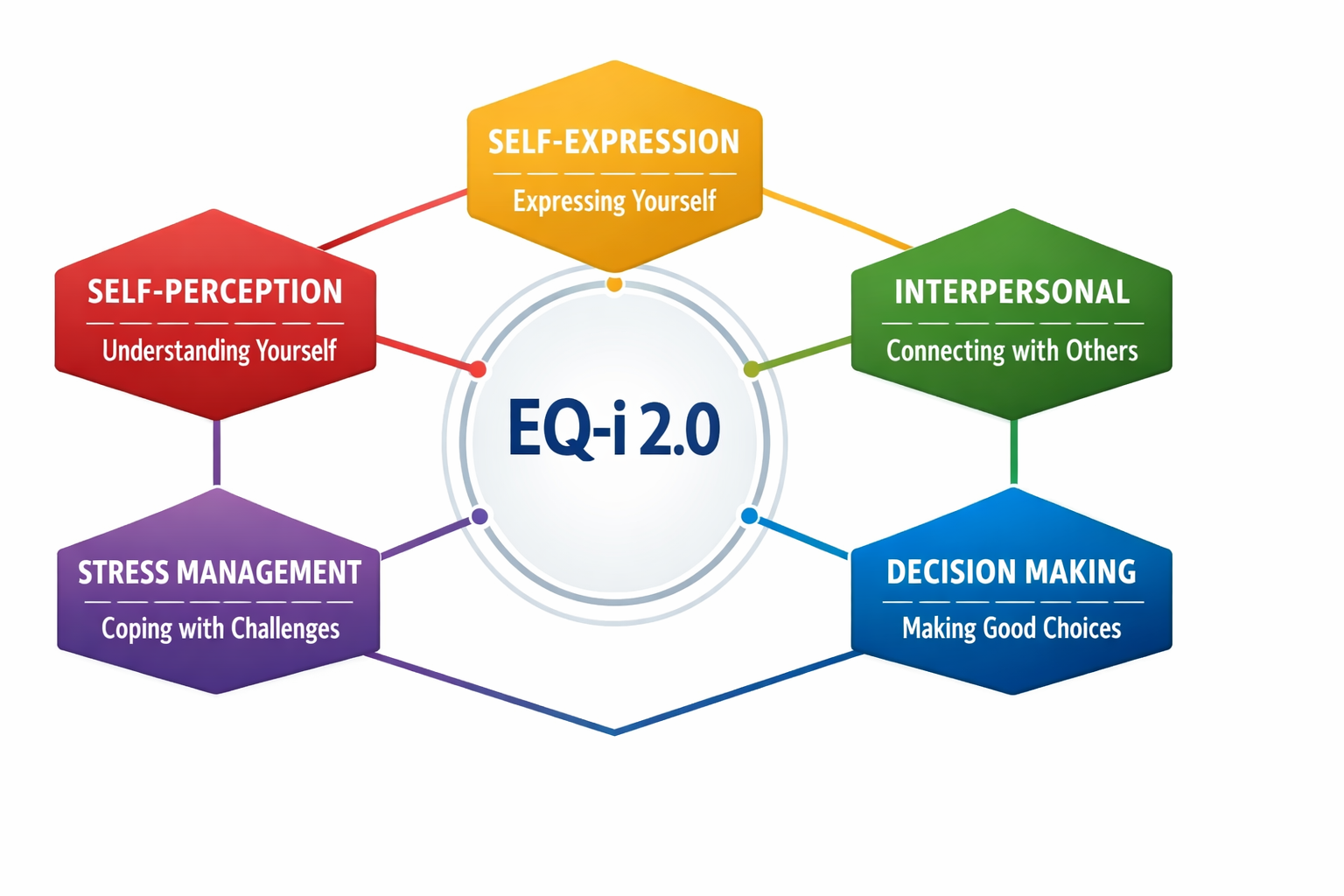
The EQ-i 2.0, which is the assessment I use most frequently for emotional intelligence development, defines EQ across five composite areas, each containing three specific scales:
Self-Perception — how clearly you understand your own emotions, strengths, and limitations. This includes Self-Regard (confidence grounded in accurate self-assessment), Self-Actualization (the drive toward meaningful personal goals), and Emotional Self-Awareness (recognizing what you’re feeling and why in real time).
Self-Expression — how effectively you communicate what you think and feel. This includes Emotional Expression (sharing emotions constructively), Assertiveness (communicating your perspective directly without aggression), and Independence (making decisions based on your own judgment rather than deferring to avoid conflict).
Interpersonal — how well you build and maintain relationships. This includes Interpersonal Relationships (creating mutually satisfying connections), Empathy (understanding and appreciating others’ feelings), and Social Responsibility (contributing to your group and community beyond self-interest).
Decision Making — how emotions inform your judgment. This includes Problem Solving (using emotional information to make better decisions, not just analytical data), Reality Testing (seeing situations accurately rather than through a lens of wishful thinking or fear), and Impulse Control (resisting the urge to act on immediate emotional reactions).
Stress Management — how you perform under pressure. This includes Flexibility (adapting to changing conditions without rigidity), Stress Tolerance (coping with difficult situations without being overwhelmed), and Optimism (maintaining a realistic but positive perspective even when things are hard).
That’s 15 separate, measurable dimensions — not a single score or a vague feeling about whether someone is “good with people.” When you break EQ into its components, development becomes specific. You’re not working on “emotional intelligence” in the abstract. You’re working on the specific imbalance that’s creating problems in your leadership.
The Patterns That Show Up Most Often in Coaching
After hundreds of EQ-i debriefs, certain patterns show up with striking regularity among leaders who are technically strong but interpersonally struggling:
High Assertiveness, low Empathy. This is the leader who speaks clearly, advocates effectively, and gets things done — but bulldozes people in the process. They genuinely don’t understand why others feel steamrolled, because from their perspective, they were just being direct. The development work isn’t about becoming less assertive. It’s about adding empathy to the repertoire so they can be direct and connected at the same time.
High Empathy, low Assertiveness. The opposite pattern, and equally common. This leader understands exactly what everyone else is feeling and consistently prioritizes others’ comfort over their own perspective. They avoid difficult conversations, over-accommodate, and then feel resentful. The development work isn’t about reducing empathy — it’s about building the assertiveness muscle so they can hold both truths: I care about you, and I need to tell you something hard.
Low Impulse Control under stress. This leader performs well under normal conditions but makes reactive, poorly considered decisions when the pressure rises. They send the email they should have sat on overnight. They make the staffing decision in the heat of frustration instead of waiting 24 hours. They snap at a direct report in a meeting and spend the next week repairing the damage. The pattern is invisible to them until they see the data — and then they can usually identify a dozen recent examples.
Low Emotional Self-Awareness across the board. Some leaders genuinely can’t identify what they’re feeling in real time. They’re not suppressing emotions — they’re not registering them. When asked “how did that make you feel?” they answer with a thought, not a feeling: “I thought it was unfair” instead of “I was angry.” This is the most foundational EQ gap because every other emotional intelligence skill depends on first knowing what you’re experiencing. If you can’t name the emotion, you can’t manage it.
How EQ Actually Develops
The good news is that unlike personality, emotional intelligence can be meaningfully developed at any age. The EQ-i 2.0 measures learned competencies, not fixed traits. The bad news is that the development process is slower and more uncomfortable than building any technical skill.
EQ develops through a cycle of awareness, practice, and feedback. First, the assessment data creates awareness of specific patterns. Then coaching provides a structured space to design behavioral experiments — small, specific changes practiced in real situations. Then feedback (from the coach, from colleagues, from the leader’s own reflection) reveals whether the new behavior is landing differently than the old one.
For the CFO I mentioned earlier, the first behavioral experiment was simple: before responding in any meeting where he felt frustrated, pause for three seconds and ask one question before stating his position. Three seconds. One question. That was the entire experiment for two weeks. It felt painfully slow to him. But his team noticed immediately. Within a month, two of his direct reports independently told him that meetings felt different — that they felt like he was actually listening before deciding. He hadn’t fundamentally changed who he was. He’d inserted a three-second gap between stimulus and response. That gap was the beginning of everything that followed.
This is why EQ development requires coaching, not just training. A workshop can explain the concept of impulse control. Only structured practice with real-time feedback can build the neural pathways that make impulse control automatic under pressure. The 70-20-10 model applies here with particular force: 10% of EQ development comes from learning the framework, 20% from coaching and feedback, and 70% from practicing new behaviors in the daily work of leading.
Three Things You Can Do This Week
1. Name your emotions with more specificity. For three days, when you notice an emotional shift — a reaction in a meeting, tension after an email, energy after a conversation — try to name the specific emotion, not just the category. Not “I’m stressed” but “I’m anxious about losing control of this timeline.” Not “I’m fine” but “I’m relieved that meeting is over.” Precision in emotional vocabulary is the foundation of emotional self-awareness, and most leaders have a working vocabulary of about five emotions when they could benefit from thirty.
2. Identify one recurring situation where your EQ gets tested. Maybe it’s the weekly leadership meeting where a particular colleague frustrates you. Maybe it’s the end of a long day when your patience thins. Maybe it’s performance conversations where you default to avoiding the hard truth. Name the situation and notice what happens in your body and your behavior when you’re in it. You’re not trying to change anything yet — you’re building the awareness that makes change possible.
3. Ask yourself whether you’re leading with your EQ strength or being limited by your EQ gap. Most leaders have both. The empathetic leader who avoids conflict is leading with empathy and being limited by low assertiveness. The decisive leader who moves fast is leading with impulse and being limited by low empathy. Knowing which pattern is yours is the starting point for targeted development — and it’s the question that an EQ-i 2.0 assessment answers with precision.
Emotional intelligence is the leadership skill that determines whether your other skills actually produce the impact they should. A brilliant strategist with low EQ alienates the people who need to execute the strategy. A compassionate leader with unbalanced EQ avoids the hard decisions that the organization needs. The path from knowing this to developing it runs through data, coaching, and structured practice — not through reading another article about empathy.
The EQ-i 2.0 is the most specific, research-backed tool available for measuring emotional intelligence across all 15 dimensions. Every assessment includes a dedicated debrief session where we connect the data to your real-world leadership challenges and identify the 2–3 development areas that would have the most impact.
Explore our assessment portfolio →
Not sure whether EQ is the right starting point for your development? A discovery call can help you figure out what data would be most useful.