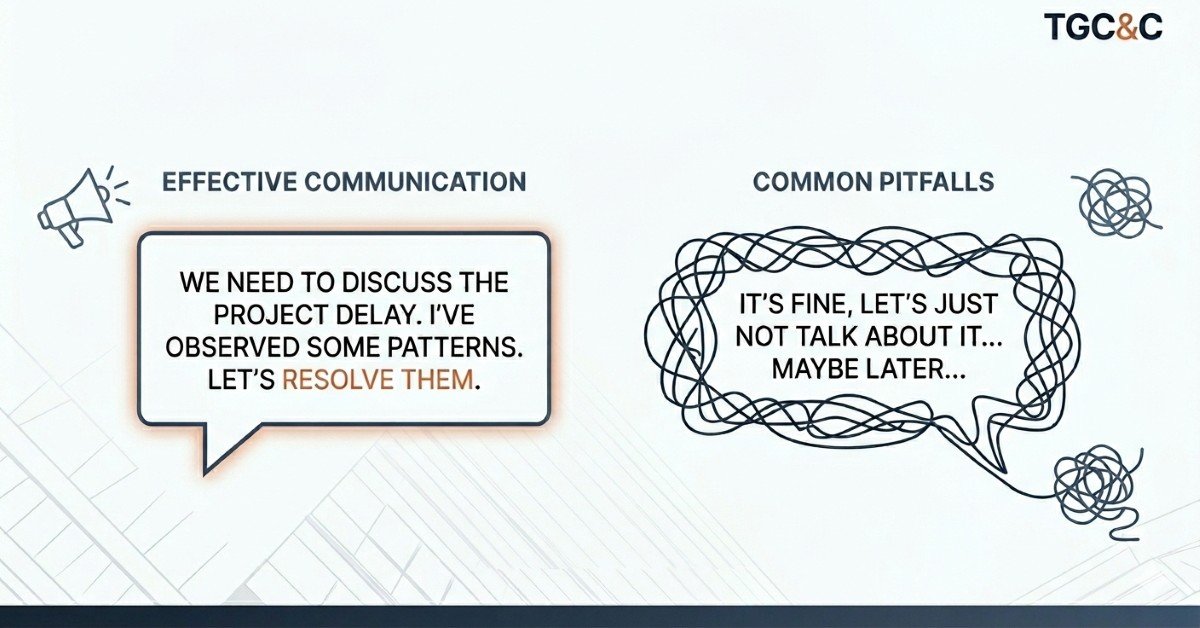
Every leader has a conversation they’ve been putting off. The performance issue that’s been festering for three months. The peer whose behavior in meetings is undermining the team. The direct report who’s not meeting the bar but doesn’t know it because nobody’s told them clearly. The compensation question from a strong performer that you’re not sure how to answer honestly.
You know the conversation needs to happen. You’ve thought about it more than once. Maybe you’ve even drafted talking points in your head during a commute or a run. But when the moment comes — the one-on-one is on the calendar, the other person is sitting across from you — something shifts. The talking points go soft. The direct thing you planned to say gets hedged. You leave the conversation feeling like you addressed it, and the other person leaves with no idea that anything was wrong.
This pattern costs more than most leaders realize. The performance problem doesn’t resolve itself — it gets worse, and now the rest of the team is watching and wondering why leadership isn’t doing anything about it. The peer conflict doesn’t fade — it calcifies into a political dynamic that slows every cross-functional initiative. The direct report who needed feedback three months ago now needs a performance improvement plan, which could have been avoided if someone had been honest earlier. The cost of avoiding a difficult conversation is almost always higher than the cost of having it badly.
Why Leaders Avoid These Conversations
The avoidance isn’t a courage problem, despite how it’s usually framed. Most leaders aren’t cowards. They’re untrained. Nobody taught them how to deliver hard feedback in a way that’s direct enough to be useful and human enough to preserve the relationship. So they default to one of two extremes:
They soften the message until it disappears. The “feedback sandwich” is the most common version of this — bury the hard thing between two compliments and hope the person extracts the middle. Most people don’t. They hear the compliments, feel good, and walk away thinking they’re doing fine. The leader feels like they delivered the feedback. The employee never received it. Both walk away satisfied, and nothing changes.
They deliver it so bluntly that the relationship takes damage. The other extreme is the leader who decides to “just be direct” without considering how the message will land. They say the hard thing, but without context, without empathy, and without a forward-looking plan. The recipient hears the criticism but not the care behind it. They leave feeling ambushed, and the next three months of the relationship are spent recovering from the delivery rather than working on the development.
Both extremes fail for the same reason: they treat the conversation as a single moment instead of a structured interaction with a preparation phase, a delivery phase, and a follow-through phase. The leaders who handle difficult conversations well don’t have thicker skin or more natural confidence. They have a framework.
A Framework That Works: Prepare, Open, Deliver, Close
Prepare: Know the three things before you walk in. Before the conversation, write down three things: (1) the specific behavior or situation you’re addressing — not a personality trait, not a pattern you haven’t documented, but a concrete, observable thing that happened or is happening; (2) the impact of that behavior on the team, the project, or the business — not how it made you feel, but what it’s actually costing; and (3) what you want to be different going forward — a specific, achievable expectation. If you can’t articulate all three before the conversation, you’re not ready to have it.
Open: Name the topic and the intent. The worst way to start a difficult conversation is to ease into it with small talk and hope the segue feels natural. It never does, and the other person spends ten minutes anxious because they can feel something coming. Start with clarity: “I want to talk about something specific, and I’m raising it because I want to help you succeed in this role, not because I’m frustrated.” That sentence does three things — it names the topic, it signals the intent, and it lowers the threat level. The person still won’t enjoy it, but they’ll be able to listen.
Deliver: Behavior, impact, expectation. This is the core of the conversation, and it should be concise. “In the last two client meetings, you committed to deliverables without checking with the engineering team first. That’s created two situations where we promised something we couldn’t deliver on time, which damaged our credibility with the client. Going forward, I need you to loop in engineering before making any commitments in client-facing settings.” That’s three sentences. Behavior, impact, expectation. No editorial. No “you always” or “you never.” No character judgment. Just what happened, what it cost, and what needs to change.
Close: Ask, listen, and agree on next steps. After delivering the feedback, stop talking. Ask: “What’s your perspective on this?” Then actually listen. The other person may have context you don’t have. They may be frustrated by a constraint you didn’t know about. They may also be defensive, in which case your job is to acknowledge the emotion without retreating from the message: “I can see this is hard to hear, and I understand. The expectation still stands.” End the conversation with a specific agreement: what’s going to change, by when, and how you’ll follow up.
The Emotional Dynamics Most People Ignore
The framework above is the structural part. The harder part is managing what happens emotionally — in both people — during the conversation.
For the person delivering the feedback, the biggest risk is the impulse to soften or retract when the other person reacts. Tears, anger, silence, defensiveness — these are normal human responses to difficult feedback, and every one of them triggers the instinct to back down. “It’s not that big a deal” or “Maybe I’m overreacting” are the phrases that undo hours of preparation. If you prepared well and the feedback is accurate, the other person’s discomfort is not a signal that you’re wrong. It’s a signal that the feedback landed.
For the person receiving the feedback, the biggest barrier to hearing it is the threat to their self-image. Research on feedback reception consistently shows that people process critical feedback through an identity lens: “If this is true, what does it say about me?” When the feedback feels like an attack on their competence or character, the defensive system activates and learning stops. This is why the behavior-impact-expectation structure matters so much — it separates the behavior from the person. “You committed to deliverables without checking with engineering” is about a behavior. “You’re not a team player” is about an identity. The first one can be discussed. The second one will be fought.
This is also where emotional intelligence data becomes directly practical. If you know from your EQ-i 2.0 that your assertiveness is low and your empathy is high, you can predict your drift: you’ll hedge, you’ll soften, and you’ll leave the conversation without having said the hard thing. If you know your assertiveness is high and your empathy is low, you can predict a different drift: you’ll be direct but blunt, and the other person will leave feeling criticized rather than coached. Knowing your pattern is the first step toward compensating for it.
The Conversations Leaders Avoid Most (and the Cost of Avoidance)
Performance that’s below the bar but not terrible. The employee who’s “fine” but not meeting the standard you need. They’re not causing problems — they’re just not contributing at the level the role requires. Leaders avoid this conversation because there’s no single incident to point to. The cost: the team recalibrates its expectations downward, other team members pick up the slack and resent it, and a year later you’re managing out someone who could have been redirected with an honest conversation at month three.
A peer whose behavior is creating problems. This is the hardest category because there’s no positional authority. You can’t direct a peer to change. But you can have a candid conversation: “I’ve noticed that in our last few cross-functional meetings, decisions we agreed on are being reopened in one-on-ones with the CEO. That’s creating confusion on both our teams. Can we talk about how to handle disagreements differently?” The cost of avoidance: the conflict becomes a political dynamic, teams align with sides, and the CEO eventually has to mediate something that two adults could have resolved directly.
Compensation or role expectations that need to be reset. The direct report who expects a promotion they’re not ready for. The employee who’s asking for a raise you can’t justify. Leaders avoid these because they feel like they’re delivering bad news. But vagueness is worse: “We’ll see how things go” leaves the person with hope that isn’t warranted, and when the answer eventually becomes clear, they feel misled. An honest conversation — “Here’s where you are, here’s what the next level requires, and here’s the gap we’d need to close” — is harder in the moment but builds more trust over time.
Three Things You Can Do This Week
1. Identify the conversation you’ve been avoiding longest. You already know which one it is. Write down the behavior, the impact, and the expectation — even if you’re not ready to have the conversation yet. Getting it out of your head and onto paper often reveals that it’s more manageable than the version you’ve been rehearsing internally.
2. Practice the opening sentence out loud. Not in your head — out loud, to yourself or to someone you trust. “I want to talk about something specific, and I’m raising it because I care about your success here.” The first 15 seconds of a difficult conversation determine the other person’s defensive posture. Getting the opening right is the single highest-leverage preparation you can do.
3. Schedule the conversation. Not “soon.” Not “when the time is right.” Put it on the calendar. The preparation framework above takes 15 minutes. The conversation itself takes 20. The cost of another month of avoidance is almost certainly higher than the discomfort of 20 minutes of honesty.
Difficult conversations are one of the most common development areas in coaching — and one of the most immediately impactful. The leader who learns to have these conversations well doesn’t just resolve the current issue. They build a reputation as someone who’s honest, fair, and trustworthy — which changes every relationship on their team.
In coaching, we work on this skill with the same rigor we bring to any other development area: assess the pattern (often through the TKI or EQ-i 2.0), design specific experiments for real conversations, and debrief what happened. The goal isn’t to make difficult conversations easy — it’s to make them effective.
Learn about our coaching approach →
Have a conversation coming up that you want to think through with someone? A discovery call is a good place to start.