I facilitated a leadership team offsite last year where the CEO opened the session by saying, “We have a trust problem and we’re going to fix it today.” He was sincere. The team had been operating in silos for months — protecting their departments, withholding information, avoiding conflict in group settings and then relitigating decisions in hallway conversations afterward. The CEO could see it. The team could feel it. Everyone agreed it needed to change.
Eight hours later, the team had shared their DiSC profiles, done a few exercises, agreed on a set of team norms, and left feeling cautiously optimistic. The CEO felt good about it. Two weeks later, almost nothing had changed. The same people were protecting the same silos, the same conflicts were being avoided, and the norms they’d written on a flip chart were already invisible.
The CEO’s instinct was right — the team had a trust problem. His timeline was wrong. Trust on a leadership team doesn’t get fixed in a day. It gets built over months of small, repeated behaviors that signal to each person on the team: I can be honest here and it will be safe. I can disagree and it won’t be punished. I can admit I don’t know and it won’t be used against me. Those signals have to be demonstrated dozens of times before they become beliefs. And a single violation can erase months of progress.
What Trust Actually Means on a Leadership Team
When people say a team “lacks trust,” they usually mean one of two things, and the distinction matters.
Competence trust is the belief that your colleagues can do their jobs. You trust the CFO to get the numbers right. You trust the VP of Engineering to deliver the product on time. This kind of trust is relatively easy to build — it comes from observing results over time. It’s also relatively forgiving. A missed deadline or a bad quarter dents competence trust, but it recovers if the pattern is otherwise strong.
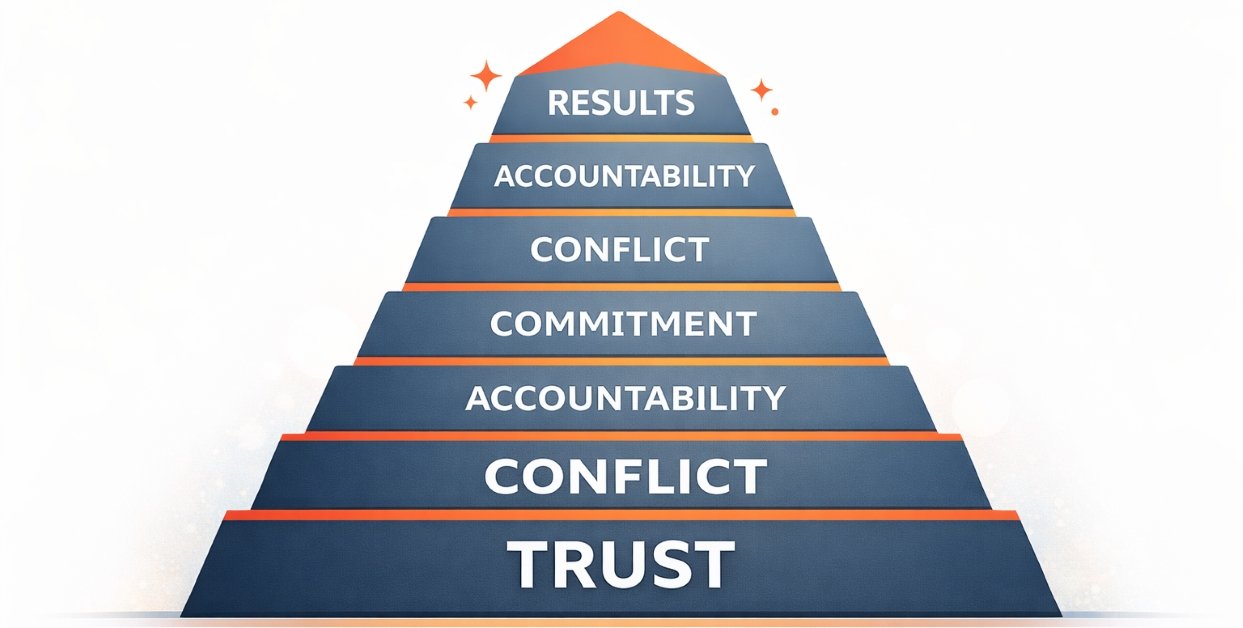
Vulnerability trust is the belief that you can be honest about your mistakes, limitations, and disagreements without it being used against you. This is the kind of trust that Patrick Lencioni identified as the foundation of functional teams, and it’s the kind that most leadership teams are missing. You can have a team where everyone respects each other’s competence and still have a team where nobody will admit they’re struggling, disagree with the CEO in a meeting, or say “I was wrong about that decision.”
Google’s Project Aristotle study, which analyzed over 180 teams to identify what makes teams effective, found that psychological safety — a concept closely related to vulnerability trust — was the single strongest predictor of team performance. Not the intelligence of the team members. Not their experience. Not their technical skills. The teams that outperformed were the ones where members felt safe to take interpersonal risks: asking questions, admitting mistakes, challenging ideas, and raising concerns without fear of embarrassment or punishment.
This finding makes intuitive sense once you see it play out. A leadership team without vulnerability trust makes decisions based on incomplete information — because people withhold their real concerns. They avoid productive conflict — because disagreement feels dangerous. They commit to decisions publicly but undermine them privately — because they never voiced their objections in the room. Every one of these patterns is a trust problem masquerading as a strategy problem, a communication problem, or a personality conflict.
Why Trust Takes So Long to Build (and So Little to Break)
The asymmetry of trust is one of the most frustrating realities of team development. Building trust requires dozens of consistent, positive interactions. Destroying it requires one.
The reason is neurological. The human brain is wired to detect threats faster and more reliably than it detects safety signals. One instance of a leader being punished for honesty — a public correction, a sarcastic response, an idea dismissed without consideration — gets encoded as a threat and changes behavior immediately. The brain doesn’t need a pattern to learn “don’t do that again.” It needs a single vivid experience. Safety, by contrast, requires repeated evidence. You need to see multiple instances of honesty being rewarded before the brain updates its model from “that might not be safe” to “it’s probably safe to speak up here.”
This explains why offsites don’t work as trust-building interventions on their own. A well-facilitated day creates one positive data point. The following week’s leadership meeting creates five more data points. If those five data points are consistent with the offsite — the CEO genuinely listens to a dissenting opinion, someone admits a mistake and it’s received with curiosity instead of blame — trust starts to build. If those five data points contradict the offsite — the CEO shuts down a disagreement, someone’s vulnerability gets exploited in a one-on-one later — the offsite is retroactively coded as performative, and trust drops below where it started.
The Behaviors That Build Trust (and the Ones That Destroy It)
Trust isn’t a feeling you generate. It’s a conclusion people draw from watching your behavior. The behaviors that build it are unglamorous, repetitive, and easy to overlook:
Follow-through on small commitments. Not the big strategic promises — the small ones. “I’ll send that by end of day” and then actually sending it by end of day. “I’ll talk to Sarah about that” and then talking to Sarah. Every kept small promise is a deposit. Every forgotten one is a withdrawal. Over time, the balance determines whether people believe what you say.
Acknowledging what you don’t know. When a leader says “I don’t have a good answer for that yet” or “I was wrong about how I handled that,” it creates permission for everyone else to be honest about their own uncertainty. This is the modeling effect that Amy Edmondson’s research on psychological safety describes: the leader’s behavior sets the team’s norms. If the leader never shows vulnerability, the team learns that vulnerability isn’t safe here.
Having difficult conversations directly instead of around. One of the most common trust-destroyers on leadership teams is the triangulated conversation: instead of telling the VP of Sales that their proposal has problems, you tell the CEO in a side conversation. The VP of Sales eventually finds out, and now the trust damage is double — you didn’t trust them enough to be direct, and you went behind their back. Direct feedback, even when it’s uncomfortable, is one of the highest-trust behaviors a team can practice.
Giving people the benefit of the doubt before assuming intent. When a colleague misses a deadline or sends a confusing email, the low-trust response is to assume incompetence or bad faith. The high-trust response is to assume good intent and ask: “Help me understand what happened.” This isn’t naïveté — it’s a discipline. And it changes the quality of every interaction on the team.
The behaviors that destroy trust are mirror images: saying one thing in the meeting and another in the hallway, making commitments you don’t keep, responding to honesty with defensiveness, playing favorites, and using information someone shared vulnerably as ammunition later. Any of these, done once in front of the team, can set trust-building back by months.
What It Looks Like When Trust Develops
The shift is gradual, and it’s often most visible in what stops happening. The hallway conversations after the meeting decrease. The careful, hedged language in group settings gives way to more direct statements. Someone says “I disagree with that approach” in a meeting and nobody flinches. The CEO asks “what are we missing?” and gets real answers instead of silence. Decisions get made faster because the debate happens once, in the room, instead of cycling through multiple side conversations.
In our Team Development Programs, we typically see the inflection point around month three or four of a structured engagement. The first month is assessment and discovery — building the shared language and data foundation. The second month is the hard part: the team starts practicing new behaviors (direct feedback, honest disagreement, public commitment) and it feels awkward and artificial. By month three, a few of those behaviors start to feel natural, and the team has enough positive data points that vulnerability begins to feel less risky. By month four, you can usually point to a specific interaction — a meeting where the team had a real disagreement, resolved it in the room, and left genuinely aligned — as the moment where something shifted.
That timeline is not what most CEOs want to hear when they say “we have a trust problem.” They want a solution, not a process. But trust is a process. It’s built through accumulated evidence, not a single intervention.
Three Things You Can Do This Week
1. Make one small promise and keep it visibly. In your next leadership team meeting, commit to a specific, small follow-up action — and then deliver it before the next meeting with a brief note to the team. This isn’t about the action itself. It’s about the signal: I do what I say I’m going to do. If every member of the team practiced this for 30 days, the trust level would shift measurably.
2. Admit one thing you don’t know or got wrong. In a group setting — not a one-on-one, where it’s easier. The leadership meeting, the town hall, the team standup. “I made a call on the timeline last month that I’d make differently now. Here’s what I’d change.” What you’re actually doing is modeling the vulnerability that gives everyone else permission to be honest. The team is watching to see what happens when the leader is imperfect. If the response is grace, the norms shift.
3. Redirect one triangulated conversation back to the direct relationship. The next time a colleague comes to you to complain about another colleague, try: “Have you told them this directly? Would it help if I facilitated that conversation?” You’re not being unhelpful. You’re being trustworthy — because you’re showing that you won’t participate in side conversations that undermine someone who isn’t in the room.
Trust is the foundation that every other team capability depends on. Without it, your conflict is political rather than productive. Your commitments are performative rather than genuine. Your accountability is punitive rather than developmental. Building it requires more patience than most leaders expect — but the return, once it’s established, compounds into every interaction the team has.
Our Team Development Programs are structured, multi-month engagements designed to build the trust, communication, and accountability that one-day events can’t produce. We start with assessments (DiSC, TKI, Hogan, or EQ-i 2.0 depending on the team’s needs), facilitate the conversations that need to happen, and provide the individual coaching and accountability structure that turns a good offsite into lasting change.
Learn about our Team Development Programs →
Not sure what your team needs? A discovery call is the place to start. We’ll talk through what you’re seeing, what’s been tried, and what approach would make sense for your team’s specific dynamics.
Schedule a discovery call →