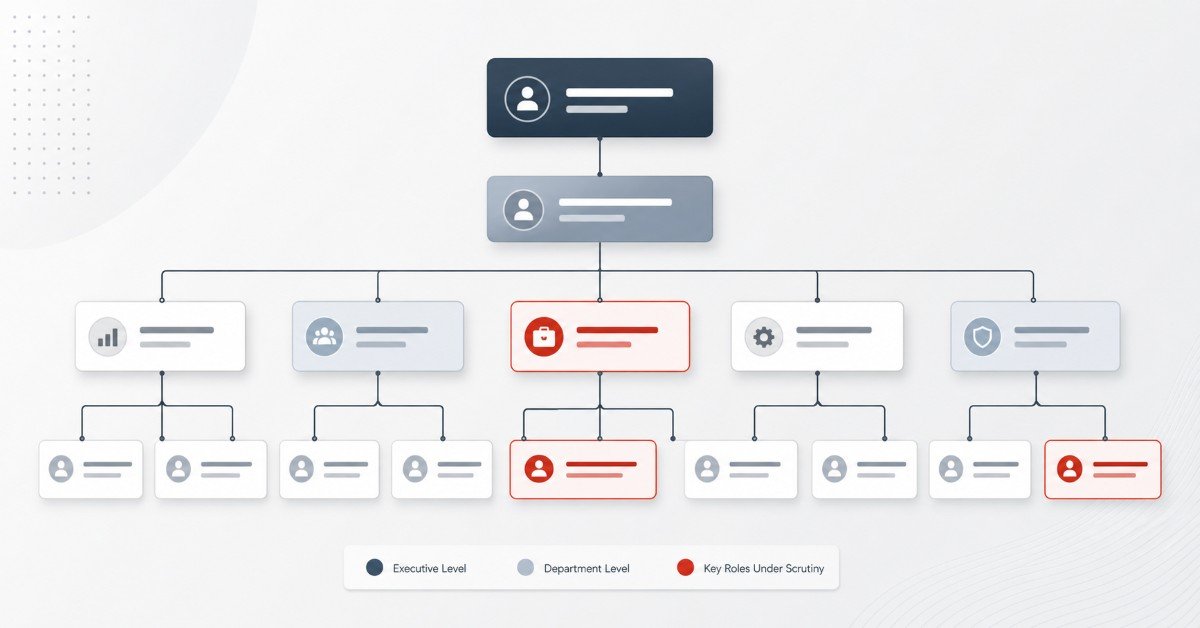
When I mention succession planning to CEOs of companies with 100 or 200 employees, I can almost see the mental filing. They hear “succession planning” and picture a Fortune 500 boardroom exercise — nine-box grids, talent committees, multi-year leadership pipelines managed by a team of 15 HR professionals. Something for companies with thousands of employees and dedicated talent management functions. Not something for them. Not yet.
That assumption is wrong, and it’s costing mid-sized companies real money. Not in the abstract “leadership development is important” sense, but in the concrete “your VP of Operations just gave notice and you have no idea who’s ready to step in” sense. The kind of cost that shows up as a panicked executive search, a six-month leadership vacuum, and a team that loses momentum at the worst possible time.
Succession planning for a company with 75 or 300 employees doesn’t look like what happens at GE or Microsoft. It’s simpler, faster, and more practical. But the underlying question is the same: if a key person left tomorrow, do you know who’s ready, who’s close, and what the gaps are?
The Risk Is More Common Than You Think
The data on this is sobering. Research from multiple sources consistently shows that roughly two-thirds of companies lack a clear succession plan for their CEO position, and the numbers are worse for roles below the C-suite — only about one in five organizations have succession plans for non-executive critical roles. A 2025 Brown Brothers Harriman survey found that only 46% of private business owners have a formal succession plan in progress, while 30% have none at all. And Bank of America’s 2025 Business Owner Report found that 40% of small and mid-sized business owners haven’t prepared for the future of their business.
These aren’t abstract statistics. They represent real organizations where the departure of one or two key people could fundamentally disrupt operations, client relationships, and growth trajectory. At a 500-person company, that disruption can cascade through entire departments. At a 100-person company, it can threaten the business itself.
The irony is that succession planning matters more at mid-sized companies, not less. Fortune 500 firms have deep benches, recruiting budgets, and brand recognition that attracts external candidates. A 150-person professional services firm doesn’t have any of those things. When your head of client delivery leaves, you can’t post the role on LinkedIn and have 200 qualified applicants by Friday. The replacement process is longer, harder, and more disruptive — which is exactly why you need to think about it before it happens.
What Succession Planning Actually Looks Like at Your Size
Forget the nine-box grid for now. At its core, succession planning is the disciplined practice of answering three questions on a regular basis:
- Which roles in this organization would create the most disruption if they were suddenly vacant?
- For each of those roles, who could step in within 90 days, who could be ready in 12–18 months, and where are the gaps?
- What are we doing right now to close those gaps — and is it working?
That’s it. If you can answer those three questions for your top 10–15 roles, you have a functional succession plan. You don’t need special software. You don’t need a talent management team. You need a structured conversation, a willingness to be honest about your bench strength, and the discipline to revisit it at least annually.
In practice, here’s what the process looks like for a company in the 50–500 employee range:
Identify your critical roles. Not every role needs a succession plan. Focus on the positions where a vacancy would cause the most operational, financial, or strategic damage. For most mid-sized companies, this is 5–15 roles: the CEO, direct reports to the CEO, and a handful of positions with specialized knowledge or deep client relationships that can’t be easily replaced.
Assess your bench honestly. For each critical role, identify internal candidates and assess their readiness. We use a simple three-tier model: Well-Placed (right role, not seeking advancement), Growth Talent (shows aspiration and capability for the next level), and Top Talent / High Potential (multiple career moves ahead, warrants accelerated development). This replaces the traditional nine-box grid with something more practical and less prone to the false precision that makes people distrust the process.
Have the calibration conversation. This is where the real value lives. Get your leadership team in a room and talk through each critical role and each potential successor. The conversation itself surfaces assumptions, disagreements, and blind spots that no spreadsheet can capture. You’ll hear things like “I assumed Sarah was being groomed for that role” and “Nobody’s talked to Marcus about what he wants” — and those revelations are worth more than any template.
Build development plans for the gaps. If your successor for the VP of Sales is 18 months away from ready, what specific development does she need? Cross-functional exposure? Executive coaching? A stretch assignment? The development plan should be concrete and time-bound, not a vague note in an HR file.
Revisit annually (at minimum). People grow, roles change, and priorities shift. A succession plan that’s reviewed once and filed away is a compliance exercise. A plan that’s revisited and updated becomes a strategic tool that drives development decisions, promotion readiness, and hiring priorities throughout the year.
The Objections I Hear (and Why They Don’t Hold)
“We’re too small for this.” You’re too small to absorb the impact of losing a key leader without preparation. That’s exactly why you need a plan. The process scales down — a 75-person company might have 5–7 critical roles and can complete a meaningful succession review in a single half-day session.
“We don’t have internal candidates ready.” That’s important information, not a reason to skip the exercise. If your succession plan reveals that you have no viable internal successors for three of your five critical roles, you now know something urgent about your talent development investment and your external hiring strategy. The alternative is finding that out the day someone resigns.
“What if people find out and get the wrong idea?” This is the most common concern, and it’s manageable. Succession planning doesn’t require announcing to employees that they’re “on the list.” It’s a leadership team exercise that informs development decisions. What employees experience is not a formal notification — it’s better development conversations, more intentional stretch assignments, and a sense that the organization is investing in their growth. Those are retention advantages, not risks.
“Our industry is too specialized — we’d have to hire externally anyway.” Even if every successor will be an external hire, succession planning is still valuable because it forces you to define what the role actually requires, identify which capabilities matter most, and start building relationships with potential candidates before you’re in crisis mode. The most expensive executive search is the one you start the day after someone leaves.
Where Companies Get Stuck
The mechanics of succession planning aren’t complicated. Where mid-sized companies get stuck is usually in one of three places:
Facilitation. It’s hard for internal leaders to run a candid talent calibration session about themselves and their peers. The CEO can’t easily facilitate a conversation about their own succession, and the HR director may not have the seniority or experience to push back when the leadership team is being unrealistic about bench strength. An outside facilitator brings objectivity and the credibility to ask uncomfortable questions.
Honest assessment. Most leadership teams overestimate their bench depth. They confuse loyalty and tenure with readiness. They assume that because someone has been in the department for eight years, they’re the natural successor — without evaluating whether they have the strategic capability, leadership presence, and temperament to operate at the next level. Assessment tools like the Hogan suite can bring data into a conversation that’s otherwise driven by gut feel and politics.
Follow-through. A succession plan without action is an exercise in anxiety reduction, not risk management. The development plans need to be executed, the readiness assessments need to be updated, and the conversations need to happen again next year. This is where having a fractional CPO or an external talent management consultant creates accountability that internal teams often struggle to maintain.
The Return on This Investment
I’ll be direct about the economics. An Executive Team Review — a structured succession planning engagement covering your top 5–10 critical roles — typically runs $8,000–$12,000 and takes four to six weeks. Compare that to the cost of a panicked executive search ($30,000–$75,000 in recruiter fees alone), the productivity loss during a leadership vacuum (conservatively 3–6 months of diminished team performance), and the cultural damage when an organization signals that it wasn’t prepared for a foreseeable event.
But the ROI isn’t just about avoiding bad outcomes. Companies that do succession planning well report meaningfully better retention of high-potential talent, because the process inherently creates development conversations and career visibility that top performers crave. When your best people can see a path forward and know that the organization is intentionally investing in their growth, they’re far less likely to take a recruiter’s call. You don’t need to be a Fortune 500 company to plan for your future. You just need to be honest about what would happen if your most critical people left — and disciplined enough to do something about it before they do.
Ready to get honest about your bench strength? Our Executive Team Review is a structured succession planning engagement that covers your top 5–10 critical roles, facilitates the calibration conversation your leadership team needs to have, and delivers a prioritized development roadmap. It’s where most first-time succession planning engagements begin.
→ Learn about Talent Management Consulting