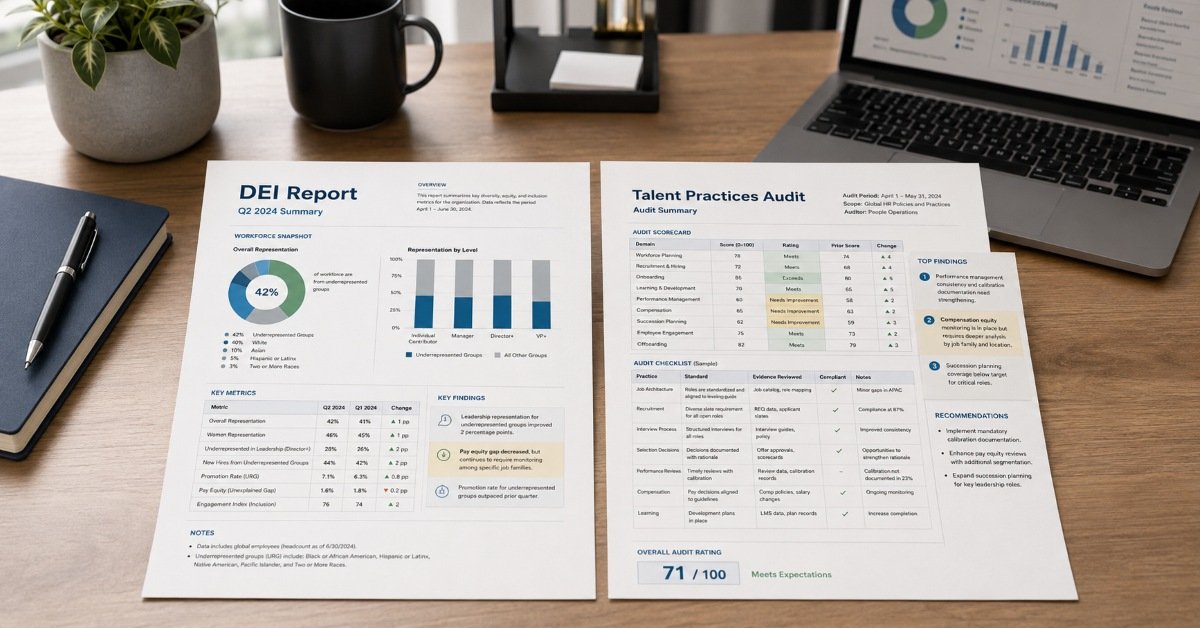
Most organizations have a DEI statement. It’s on the website, in the investor deck, and referenced at the annual town hall. The statement typically commits to creating an inclusive environment, valuing diverse perspectives, and ensuring equitable treatment for all employees. It’s usually sincere.
It’s also usually disconnected from anything that would produce different outcomes. The same hiring process that screens for “culture fit” (which often functions as demographic similarity) is still in place. The same promotion criteria that weight executive presence and visibility (which often advantage those who look like existing leadership) haven’t been examined. The same compensation structure that pays based on negotiation leverage (which research consistently shows produces demographic disparities) hasn’t been audited. The statement says one thing. The systems produce another. And nobody has built the measurement infrastructure to make the gap visible.
This isn’t hypocrisy. It’s the difference between commitment and accountability. Commitment is a decision about values. Accountability is a system for tracking whether those values are producing different outcomes in the talent practices that determine who gets hired, who gets developed, who gets promoted, and who gets paid equitably. Most organizations have the first and lack the second.
Why Training Alone Doesn’t Change Outcomes
The default DEI investment at most mid-sized companies is training: unconscious bias workshops, inclusion awareness sessions, cultural competency programs. These investments build awareness, which matters. But research is increasingly clear that awareness-focused training, on its own, rarely produces sustained changes in organizational outcomes.
The reason is structural. Individual awareness can’t overcome systemic process design. A manager who has completed an excellent bias training course will still produce biased hiring outcomes if the interview process relies on unstructured conversations, subjective assessments, and cultural fit criteria that are never defined in behavioral terms. The system produces the outcome. The training produced the awareness. But the system didn’t change.
This is why we approach DEI as an organizational design challenge, not a training problem. The question isn’t “are our people aware of bias?” It’s “are our systems designed to produce equitable outcomes regardless of individual bias?” That’s a harder question, and it requires examining specific processes rather than delivering general education.
The Four Talent Systems That Determine Equity
If you want to know whether your organization is producing equitable outcomes, examine these four systems. They’re where the gap between the DEI statement and the lived experience is most measurable:
1. How you hire. Examine your talent pipeline at each stage: who applies, who gets screened in, who gets interviewed, who gets offered, and who accepts. If the diversity of your pipeline narrows significantly at any stage, that stage has a design problem. Common culprits: job descriptions that use gendered language, sourcing strategies that rely on networks that mirror existing demographics, interview panels that lack diversity, and “culture fit” criteria that have never been defined in behavioral terms. A structured hiring process with standardized questions, predefined competencies, and calibrated evaluation criteria doesn’t just produce better hires — it produces more equitable hires, because it reduces the space for subjective preference to override evidence.
2. How you promote. Track who gets promoted, how long it takes, and what criteria are applied. In many organizations, promotion decisions are heavily influenced by visibility, sponsorship, and self-advocacy — all of which are affected by demographic factors. If certain groups are consistently promoted faster or at higher rates than others, the question isn’t whether the promoted individuals deserved it (they probably did). It’s whether the system gave everyone an equal opportunity to demonstrate readiness. A transparent promotion framework with defined criteria, structured talent reviews, and calibration conversations changes the system. An unconscious bias workshop does not.
3. How you pay. Pay equity analysis is one of the most concrete and actionable DEI interventions available. It answers a specific question: controlling for role, level, experience, geography, and performance, are there statistically significant pay differences by gender, race/ethnicity, or other demographic factors? If there are, the gap isn’t always intentional — it’s often the accumulated result of years of negotiation-based pay decisions, market adjustments that weren’t applied consistently, and starting salary differences that compound over time. The solution is a compensation philosophy and salary structure that creates consistency, paired with a regular pay equity review that identifies and closes gaps before they become legal exposure.
4. How you develop. Who gets access to stretch assignments, coaching, executive exposure, and formal development programs? In many organizations, the answer correlates with demographics in ways that are invisible until measured. High-potential programs that disproportionately identify people who look like existing leadership. Stretch assignments that go to the people who are already visible rather than the people who would benefit most. Coaching investments concentrated in the most senior (and often least diverse) layer of leadership. Equitable development doesn’t mean equal treatment — it means examining whether the allocation of development resources is producing a leadership pipeline that reflects your full talent base.
What Accountability Infrastructure Looks Like
Accountability is the bridge between aspiration and outcome. Without it, DEI work tends to follow a predictable cycle: enthusiasm after a catalyzing event (a social movement, a board request, an employee incident), a burst of activity (training, a task force, a statement), gradual attention drift as other priorities reassert themselves, and a return to baseline until the next catalyzing event.
Breaking this cycle requires three elements:
Metrics that track outcomes, not activities. The number of trainings delivered, the percentage of employees who completed them, and the existence of a DEI committee are activity metrics. They tell you what you did. Outcome metrics tell you what changed: representation at each level of the organization, promotion rates by demographic group, pay equity ratios, engagement scores by population, and voluntary turnover rates by demographic segment. Activity metrics are comfortable because they’re always positive (you did the training — check). Outcome metrics are uncomfortable because they reveal whether the activities produced any difference. That’s exactly why they matter.
Leadership ownership with reporting cadence. Every DEI initiative needs a specific leader (not “the DEI committee”) who owns the outcome and reports on progress with the same regularity and rigor as financial or operational metrics. If DEI progress is reviewed quarterly alongside revenue and operational targets, it signals organizational seriousness. If it’s discussed at the annual retreat and forgotten the rest of the year, it signals that the commitment is aspirational, not operational.
Integration into existing talent processes rather than a parallel track. DEI should not be a separate department, a separate initiative, or a separate conversation from the core talent management work. It should be embedded: equity questions built into the hiring process, calibration protocols that specifically examine for demographic patterns in performance ratings, pay equity analysis conducted as part of the annual compensation cycle, and development allocation reviewed through an equity lens during talent reviews. When DEI is a layer on top of existing processes rather than woven into them, it will always be deprioritized when bandwidth gets tight.
Starting Without Overcommitting
One of the reasons DEI progress stalls at mid-sized companies is that the scope feels overwhelming. A full DEI strategy, an equity audit of every talent practice, an inclusive leadership development program, an ERG strategy, and a metrics framework — it’s a lot. And companies that try to do everything at once usually do nothing well.
The practical starting point is data. Before you design interventions, understand where you actually stand. Two diagnostic steps give you 80% of what you need to prioritize:
Run a pay equity analysis. This is the most concrete, most defensible, and most immediately actionable DEI diagnostic. It produces specific, quantifiable findings that leadership can act on. If you have pay gaps, you can close them. If you don’t, you can communicate that to your workforce with confidence. Either outcome is valuable, and the analysis typically takes four to six weeks.
Examine your hiring and promotion data through a demographic lens. Pull two years of hiring data and track the funnel by demographic group: applicants, interviews, offers, hires. Do the same for promotions: who was considered, who was promoted, and how long it took. If the data reveals significant disparities at specific stages, those stages are your highest-priority process redesign targets. If the data shows equitable outcomes, you have evidence to support what’s working — and can focus attention elsewhere.
Both of these steps are evidence-based, politically navigable, and produce findings that reasonable people across the political spectrum can engage with. They’re also the steps most likely to reveal the specific interventions that will have the most impact for your organization — rather than the generic interventions that everyone does because they’re visible.
Three Things You Can Do This Week
1. Ask yourself: do we measure DEI outcomes, or just DEI activities? If the answer is activities only (trainings completed, events held, committee meetings attended), the accountability infrastructure isn’t in place yet. Start by identifying one outcome metric you can track with data you already have: promotion rates by demographic group, or representation at each organizational level compared to last year.
2. Pull your pay data for one role where you have five or more employees at the same level. Compare the pay across the group. Are there differences that can’t be explained by geography, performance, or experience? If so, you have a pay equity signal that warrants a broader analysis. If not, that’s one data point toward confidence in your compensation practices.
3. Examine your last 10 promotions. Look at who was promoted, how the decision was made, and what criteria were applied. Were the criteria consistent? Were they documented? Were candidates from underrepresented groups considered? If the honest answer to any of these is “I’m not sure,” the promotion process may be producing inequitable outcomes that a more structured approach would address.
DEI accountability isn’t about perfection or performative compliance. It’s about building the systems and measurement infrastructure that allow your organization to see where equity gaps exist, address them with targeted interventions, and track whether those interventions are producing different outcomes over time. That’s rigorous work. It’s also the only kind of DEI work that actually changes anything.
We help organizations move from DEI commitment to DEI accountability — through strategy assessment, equity audits of talent practices, inclusive leadership development, and metrics and accountability framework design. Every engagement starts with data: understanding where your organization actually stands before recommending where to invest. Learn about our DEI Consulting approach →
Not sure where to start? A discovery call can help you assess what you have, identify what’s missing, and determine the right first step. Schedule a discovery call →