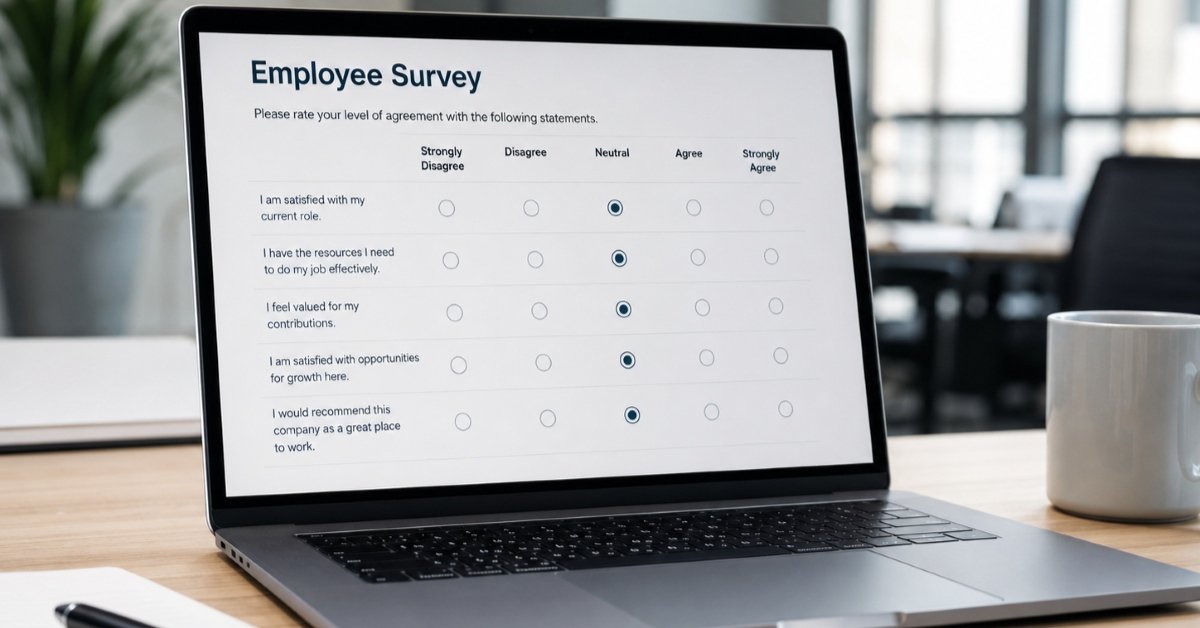
A CEO showed me his company’s engagement survey results last year with a mix of pride and confusion. “Our overall score is 78%,” he said. “But we lost 22% of our team last year, including four people I thought were our strongest performers. The numbers don’t match what I’m seeing.”
They didn’t match because the numbers were wrong. Not statistically wrong — the math was fine. Behaviorally wrong. The survey was measuring what people were willing to say, not what they actually felt. The questions were generic. The confidentiality felt questionable because the HR team administered it through their own HRIS and the population in some departments was small enough that individuals could be identified. And two years earlier, the company had run the same survey, collected the data, and done nothing with it — which taught every employee in the building that the survey was a compliance exercise, not a genuine request for input.
His engagement score was 78%. His actual engagement was significantly lower. The gap between those two numbers was the cost of a survey process that nobody trusted.
Why Employees Don’t Trust Your Survey
Employee skepticism about engagement surveys is rational, not cynical. It’s based on experience. And the reasons are consistent across organizations:
They’re not convinced their responses are confidential. This is the foundational trust issue. If employees believe their individual responses could be identified — or even suspect it’s possible — they’ll give safe, neutral answers. The smaller the team, the larger the concern. A department with six people knows that a manager reviewing engagement data for their team is looking at a very small pool. “Anonymous” doesn’t feel anonymous when your manager can reasonably guess who said what. The confidentiality architecture of the survey — minimum reporting thresholds, third-party administration, clear communication about data handling — is a design decision that determines whether you get honest data or performative compliance.
The last survey didn’t change anything. This is the most common and most damaging trust-killer. An organization runs a survey, collects the data, maybe shares a summary at a town hall, and then … nothing visibly changes. The issues employees raised are still there six months later. No action plan was communicated. No follow-up happened. The reasonable conclusion: telling the truth didn’t produce any benefit, so why bother being honest next time? Every survey that collects data without producing visible action makes the next survey less trustworthy. The damage is cumulative and takes years to reverse.
The questions don’t reflect their actual experience. Generic surveys ask generic questions: “I feel valued at work.” “My manager supports my development.” “I understand the company’s strategy.” These questions aren’t wrong, but they’re not calibrated to the specific dynamics of the organization. If the real engagement driver at your company is the gap between the espoused values and the actual decision-making process, a generic survey won’t surface it — because no generic survey asks about it. Custom questions designed for your organization’s specific context produce data that employees recognize as relevant, which increases both response quality and trust in the process.
They suspect the survey is designed to produce a good number, not an honest picture. When the survey feels like it’s optimized for benchmarking rather than understanding, employees notice. Questions that are phrased to elicit positive responses. Rating scales where the neutral midpoint is labeled “satisfied” rather than “neutral.” Results presented as a single headline score (“We’re at 78%!”) rather than a nuanced analysis of what’s working and what isn’t. The survey feels like a marketing exercise aimed at leadership’s comfort, not a diagnostic aimed at organizational improvement.
What a Trustworthy Survey Process Looks Like
Fixing a broken survey isn’t about choosing a better platform or writing better questions — although both matter. It’s about redesigning the entire process so that employees have rational reasons to trust it. That means addressing confidentiality, relevance, and follow-through simultaneously.
Separate the survey from internal HR administration. The single most effective trust intervention is having the survey designed and analyzed by someone outside the organization. Not because your HR team is untrustworthy, but because the perception of independence matters. When an external partner designs the questions, the organization deploys through a survey platform they own, and the external partner analyzes the results — the confidentiality architecture is credible because the people who see the individual responses are not the people who make employment decisions. This isn’t about outsourcing your survey. It’s about creating a separation that makes honesty safer.
Design custom questions for your organization. Start with the specific hypotheses you’re testing. If leadership suspects that manager quality is driving turnover, design questions that assess manager effectiveness across specific behaviors — not just “my manager supports me” but “my manager gives me regular, actionable feedback” and “my manager has discussed my career development in the past six months.” If the concern is trust in leadership, ask about specific trust behaviors: “When leadership commits to a change, I believe it will happen.” Custom questions signal to employees that the organization is asking about things that matter, not running a generic template.
Set minimum reporting thresholds. No manager should see results for a group smaller than a defined minimum — typically 5–8 respondents. This is a basic confidentiality protection, but many organizations either don’t set the threshold or set it too low. Communicate the threshold explicitly to employees before the survey launches: “No results will be reported for any group with fewer than [X] respondents.” This single sentence addresses the small-team concern that kills trust in most surveys.
Combine quantitative and qualitative methods. Survey data tells you what. It doesn’t tell you why. A question about manager effectiveness that scores poorly across one department is useful data — but it doesn’t tell you whether the problem is feedback quality, micromanagement, lack of development conversations, or a specific interpersonal dynamic. Focus groups and stay interviews — conducted by someone other than the employees’ managers — provide the qualitative context that makes survey data actionable. Without the qualitative layer, you’re guessing at root causes, and your action plan is built on assumptions.
Commit to visible action before you launch. This sounds counterintuitive, but the commitment to act on results needs to happen before the survey launches, not after the results come in. Leadership should communicate, at the point of survey invitation: “We’re conducting this survey because we want to understand what’s working and what isn’t. We commit to sharing the key findings with the organization and to acting on at least three specific issues the data reveals within 90 days.” That commitment — made publicly, with a specific timeline and a specific number of actions — changes the employee calculus from “nothing will happen” to “they’ve promised to do something, and now they’re on the hook.”
The Action Gap: Where Most Surveys Die
The survey has been designed well, deployed thoughtfully, and analyzed rigorously. The data reveals three clear findings: manager effectiveness is the primary engagement driver, career visibility is the biggest gap, and trust in leadership’s follow-through is the biggest risk. Now what?
This is where most engagement processes collapse. The data gets presented to leadership. Leadership nods, acknowledges the findings, and assigns the action items to HR — who adds them to an already full plate and does their best. Six months later, employees notice that the same issues persist, and their cynicism about the next survey deepens.
Closing the action gap requires three things that most organizations skip:
Prioritize ruthlessly. You can’t address everything the survey reveals. Pick the two or three issues that will have the most impact and focus on those. Communicate to the organization what you’re focusing on and why — and equally importantly, what you’re not addressing yet and why. Employees respect honest prioritization. What they don’t respect is a vague promise to “work on everything.”
Assign ownership with accountability. Each action item needs a specific owner (not “HR” but “Jamie, VP of Operations”), a specific deliverable, and a specific timeline. The owner should report progress to the leadership team on a regular cadence, and the leadership team should hold them to it the same way they hold people accountable for financial targets.
Close the loop visibly. When action has been taken, tell people. Not in a buried email — in a visible, specific communication: “You told us that career development conversations weren’t happening consistently. We’ve implemented a quarterly development conversation framework and trained all managers on how to use it. Here’s what that looks like.” The visible closure is what rebuilds trust for the next survey. People need to see that their input produced a change — not just an acknowledgment.
Three Things You Can Do This Week
1. Ask five employees, informally, whether they trusted the last engagement survey. Not whether they filled it out — whether they trusted it enough to answer honestly. The candor of their answers will tell you more about your survey’s reliability than any response rate metric.
2. Look at what happened after your last survey. Were the results shared with employees? Were specific actions taken? Were those actions communicated back? If the honest answer is “not really,” that’s the primary barrier to trust in your next survey — and it needs to be addressed before you deploy again.
3. Evaluate whether your current survey asks questions specific to your organization. Pull up the last survey and read the questions as if you were an employee. Do they address the dynamics that actually drive engagement at your company? Or could they apply to any company in any industry? If the questions feel generic, the data they produce is almost certainly too shallow to act on.
An engagement survey done right is one of the most valuable diagnostic tools an organization has. Done wrong, it’s worse than not surveying at all, because it produces data leadership trusts and employees don’t — which means the decisions made from it are built on a foundation of polite fiction.
Our Engagement Diagnostic is built on doctoral research in employee engagement and designed to produce data you can actually trust. We design custom survey questions for your specific organization, recommend the right survey platform so your team deploys and owns the data, and combine quantitative analysis with qualitative deep dives — focus groups and stay interviews conducted by us, not your managers — to reveal the story behind the scores. The deliverable isn’t a number. It’s a prioritized strategy. Learn about our engagement and retention approach →
Planning a survey and want to get it right from the start? A discovery call can help you design the process before you deploy it. Schedule a discovery call →