I coached a newly promoted VP of Engineering last year who was drowning. Not in the work — she understood the technical landscape better than anyone in the company. She was drowning in the realization that the things she was best at were no longer the things she was supposed to be doing.
For fifteen years, she’d been the person who solved the hardest problems. When a system went down, she was the first one in the war room. When the architecture needed rethinking, she led the design. When the team hit a wall on a complex build, she rolled up her sleeves and wrote code alongside them. That’s what got her promoted — again and again — to the point where she was now responsible for 40 engineers across four teams and a $12 million budget.
But the VP role didn’t need her to solve engineering problems. It needed her to build a leadership team that could solve them without her. It needed her to think about organizational design, talent development, stakeholder management, and strategic prioritization — none of which felt like real work to her. Real work was the technical problem she could feel in her hands. Everything else felt like overhead. And so she kept getting pulled back into the technical details, her team leaders stopped making decisions because they knew she’d overrule them anyway, and six months in, she was more stressed and less effective than she’d been as a director.
Her problem wasn’t competence. It was identity. She didn’t know how to be valuable if she wasn’t the person solving the hardest problem in the room.
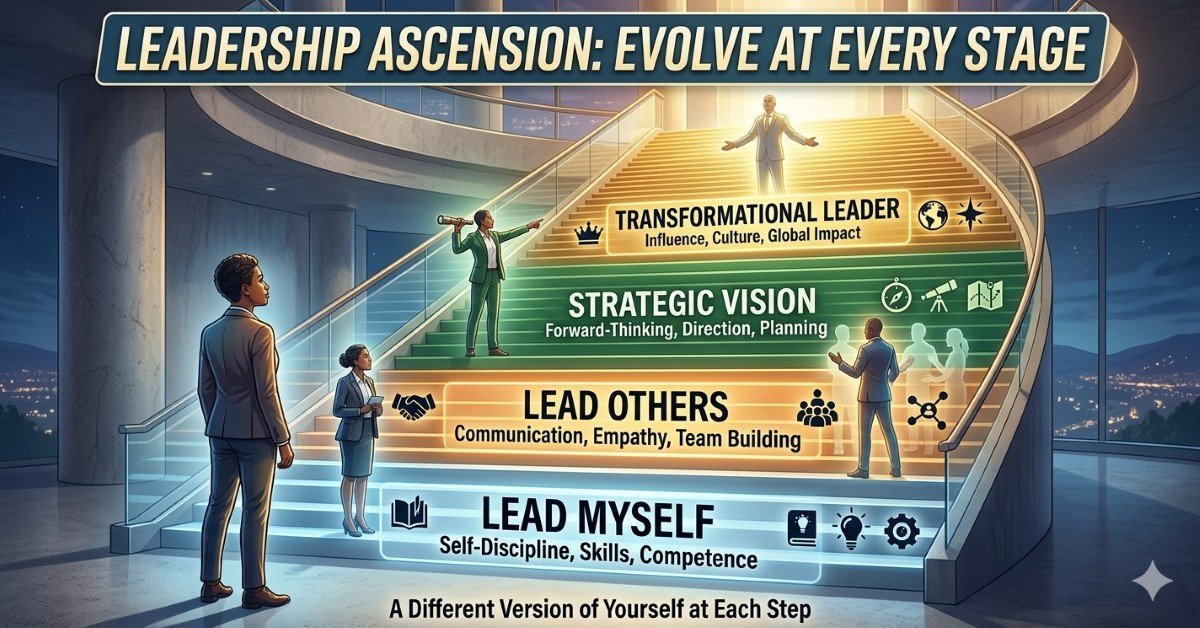
Every Promotion Requires a Different Version of You
Marshall Goldsmith titled his most famous book with the insight that animates this entire problem: what got you here won’t get you there. It’s one of those ideas that’s easy to agree with intellectually and devastatingly hard to live. Because the behaviors that got you promoted aren’t just skills you deployed strategically. They’re woven into your identity. They’re how you know you’re adding value. They’re the answer to the question every leader is silently asking:
Am I good enough to be here?
When you move from individual contributor to manager, the shift is from personal output to team output. Your value is no longer measured by what you produce but by what your team produces. For someone who built their identity around being the best performer on the team, this feels like being asked to stop doing the thing that makes them them.
When you move from manager to director, the shift is from managing tasks to managing systems. You’re no longer in the daily details — you’re designing the processes, structures, and cadences that allow other managers to succeed. For someone who built their identity around being the manager who knew every detail, this feels like losing control.
When you move from director to VP or C-suite, the shift is from managing systems to managing ambiguity. The problems are less defined, the feedback loops are longer, the political complexity is higher, and the decisions you make affect people you’ll never meet. For someone who built their identity around having the right answer, this feels like permanent incompetence — because at this level, there often isn’t a right answer.
Each of these transitions requires letting go of the behaviors that made you successful at the previous level. And letting go of what made you successful feels, at a visceral level, like letting go of what makes you valuable. That’s why it’s an identity problem, not a skill problem. The VP of Engineering didn’t lack the skills to lead at a higher level. She lacked the internal permission to stop being the technical hero.
The Patterns That Signal a Stalled Transition
In coaching, I see the same patterns across industries and levels. A leader gets promoted, brings their old playbook to the new role, and then wonders why it isn’t working. The patterns are predictable:
The doer who can’t delegate. They were promoted for their ability to produce exceptional work. Now they’re supposed to develop others who produce the work. But nobody else does it as well or as fast, so they take it back. Their direct reports stop growing because they never get to own anything. The leader works 60-hour weeks and can’t understand why the team isn’t stepping up.
The expert who can’t let go of technical credibility. They built their reputation on being the smartest person in the room on a specific topic. At the new level, the strategic questions require breadth, not depth. But they keep pulling conversations back to their area of expertise because that’s where they feel confident. Their peers see it as territorial. Their boss sees it as not operating at the right altitude.
The achiever who measures value by visible output. They’re used to producing deliverables — analyses, presentations, plans. At the new level, the most valuable thing they can do is often invisible: a coaching conversation that shifts someone’s thinking, a behind-the-scenes negotiation that clears a political obstacle, a strategic decision to say no to something. But because these don’t feel like “real work,” the leader fills their calendar with activity instead of impact.
The people-pleaser who can’t make unpopular decisions. They were promoted partly because everyone liked working with them. At the new level, the decisions are harder and someone is always unhappy. The restructuring that makes strategic sense. The performance conversation that needs to happen. The budget cut that affects a team they care about. They delay, they seek consensus beyond what’s reasonable, and the organization loses momentum while the leader tries to find a path where nobody is upset.
If you recognize yourself in any of these patterns, you’re not failing. You’re in a normal — and temporary — stage of a leadership transition. The question is whether you stay stuck there or move through it.
How the Shift Actually Happens
The leadership identity shift doesn’t happen through reading a book about it (including this article). It happens through the same mechanism that drives all meaningful development: awareness of the pattern, discomfort with the consequences, and structured support to try new behaviors.
Assessment data accelerates awareness. A Hogan HDS debrief can show a newly promoted leader exactly which stress behaviors are likely to intensify at the new level. A 360-degree feedback process can reveal how the old playbook is landing with the people around them — the direct reports who feel micromanaged, the peers who feel steamrolled, the boss who sees potential but worries about altitude. Data turns a vague sense of “this isn’t working” into a specific understanding of what needs to change.
Coaching provides the space to practice a new identity. The hardest part of any leadership transition is the period between letting go of the old behaviors and trusting the new ones. In that gap, you feel incompetent. You’re not the technical hero anymore, and you’re not yet the strategic leader. Coaching provides a confidential space to process that discomfort, design experiments (“This week, I’m going to let my team lead the problem-solving session and only speak if they ask for input”), and reflect on what happened. The coach holds the long view when the leader can only see the awkwardness of the moment.
Time and evidence build the new identity. Eventually, the leader has enough positive experiences at the new level that the new behaviors start to feel like their own. The VP of Engineering I mentioned earlier had her inflection point about four months in, when one of her team leads solved a major technical problem without involving her and she felt proud instead of anxious. That emotional shift — from “they don’t need me” to “I built a team that doesn’t need me, and that’s the point” — was the moment her leadership identity caught up with her leadership role.
Three Things You Can Do This Week
1. Identify the behavior from your previous level that you’re still relying on most heavily. What’s the thing you default to when the pressure rises? Is it diving into the technical details? Taking back a task someone else should own? Seeking consensus when a decision is yours to make? Name it specifically. The behavior isn’t wrong — it was right at the previous level. The question is whether it’s serving you at this one.
2. Ask yourself: what does my current role need from me that my old role didn’t? Write down two or three things that are clearly part of your new job that weren’t part of your old one. Organizational thinking. Cross-functional influence. Developing other leaders. Strategic prioritization. Now estimate what percentage of your week you’re actually spending on those things versus on the comfortable work from your previous role. The gap between those two numbers is the size of your transition challenge.
3. Find one moment this week to let someone else be the expert. In a meeting where you’d normally provide the answer, ask a question instead. Let your team lead present the solution. Sit with the discomfort of not being the one who solved it. Notice what happens — both in the room and in your own head. That small experiment is the beginning of the identity shift: discovering that your value at this level comes from enabling others, not from being the smartest person in the room.
Leadership transitions are the moments where coaching has the highest impact — because the leader is already feeling the discomfort that creates readiness, and the stakes are high enough that change feels urgent. Assessment data sharpens the awareness. Structured coaching provides the support to navigate the gap between the old identity and the new one. And the result is a leader who doesn’t just occupy the role but operates at the level the role demands.
Every coaching engagement at TGC&C is built for this kind of development — assessment-driven, focused on behavioral change, and structured to bridge the gap between insight and action.
Learn about our coaching approach →
Navigating a leadership transition right now? A discovery call is a good place to start. We’ll talk through where you are, what’s shifting, and what support would be most useful.